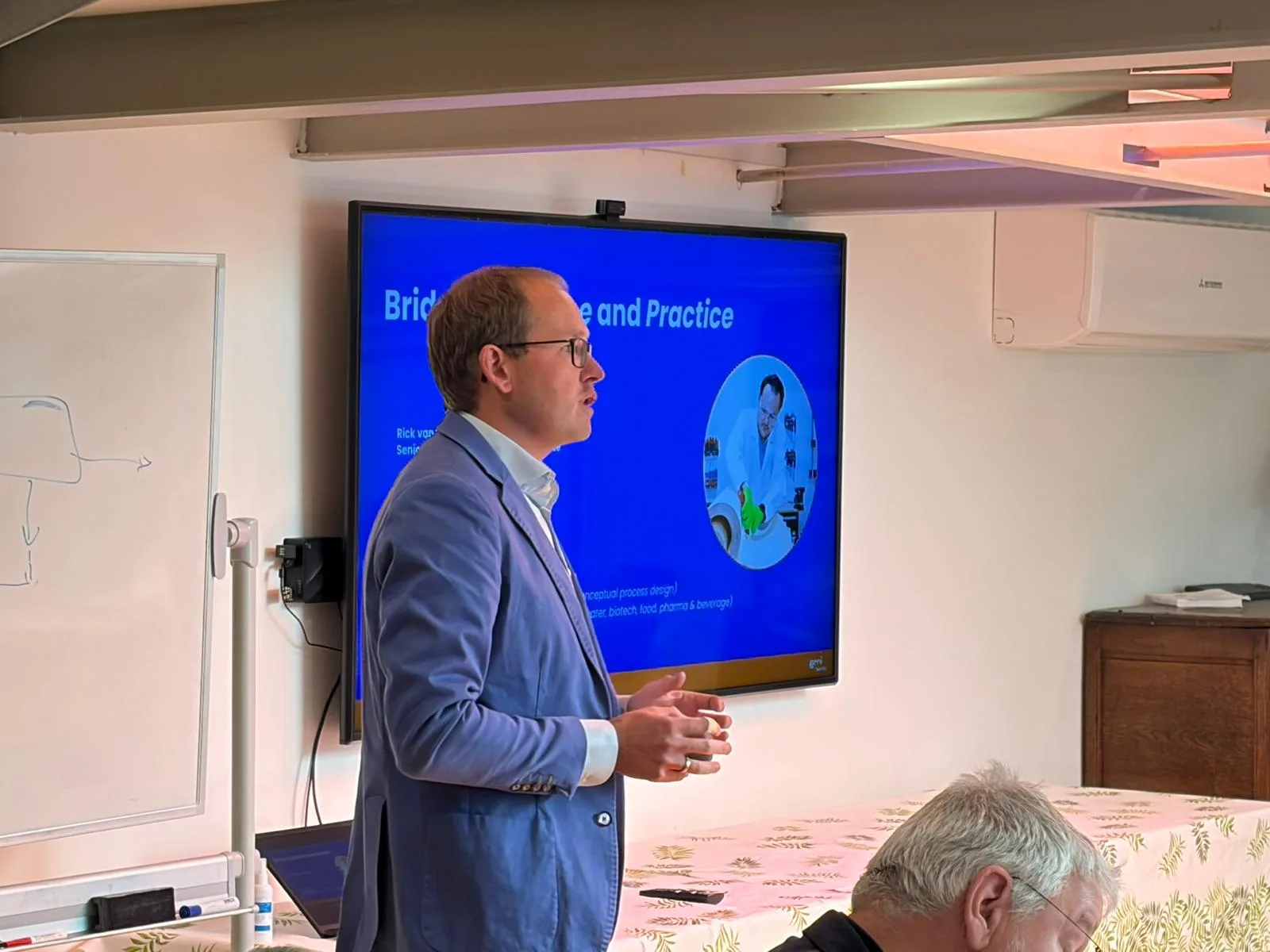
On 12 May 2026, the Nederlands Membranengenootschap (NMG) and NL GUTS held their joint Membrane Separations symposium at Lenntech in Delfgauw, bringing together around fifty people from industry, research and technology suppliers for a day of presentations, a facility tour and plenty of conversation in between. EMI Twente was on the programme to talk about what arguably keeps our lab the busiest: membrane autopsy.
Rick van Lin was originally scheduled to present. A last-minute change meant Patrick stepped in — thanks to Rick for the handover.
Bridging Science and Practice
The title of the talk was no coincidence. A membrane autopsy is, on the surface, a fairly technical exercise: a used element comes back from a plant, we take it apart, characterise it, and write up what we find. But the value of an autopsy lives in the translation step; turning lab observations into operational decisions that actually change something on Monday morning. Three threads ran through the presentation:
Fouling is layered, not singular
When operators describe a failing membrane, the story is often clean: “we’re seeing biofouling,” or “it must be scaling.” In practice, what we open up in the lab almost always shows several mechanisms at once. Biofilm provides anchor points for organics; scaling tends to form where biofilm has shielded the surface from cleaning chemicals; mechanical damage at the spacer creates new sites for everything to accumulate. The sequence in which these layers built up usually tells us more about the upstream process than any single technique would on its own.
Visual inspection still earns its keep
Modern lab techniques, such as SEM/EDX, FTIR, XPS, are powerful, and we use them on virtually every job. But the first hour of an autopsy is still a careful visual and tactile inspection: how the element looks when the housing comes off, where deposits sit relative to the spacer pattern, how feed and concentrate ends compare, whether telescoping or O-ring extrusion is present. That inspection is what tells the analytical work where to look. Skip it, and you risk an expensive report that confirms what you already suspected without explaining why.
From “what we found” to “what to change”
A good autopsy report is not the deliverable, the operational change is. Almost every autopsy ends with a small set of practical recommendations a plant operator can act on: an adjustment to pretreatment dosing, a different CIP protocol, a tightened operating window, a revised specification for the next replacement cycle. We try to write reports or slide decks that make this last step short. The lab work is upstream of the decision; it should not be the bottleneck for it.
Closing the feedback loop
There is a second audience for every autopsy: the people who design membranes and systems. Patterns we see across many elements; particular failure modes appearing in particular sectors, or under particular cleaning regimes. They eventually feed back into specification choices, module selection and process design. The same diagnostic work that helps one plant on Monday also informs how we design for the next plant on Tuesday. That feedback loop is, in the end, what Bridging Science and Practice means in our day-to-day work.
Beyond autopsy
Autopsy is one slice of what we do at EMI Twente. The same team works upstream and downstream of it:
- Membrane and process testing bench- and pilot-scale trials to characterise performance on real feed streams, before a process choice is locked in.
- Conceptual process design translating separation goals into a workable membrane configuration, including pretreatment, staging and cleaning strategy.
- Troubleshooting and consultancy supporting operators when a system isn’t behaving the way the original design promised.
The thread connecting these is the same one that ran through the talk: bridging the science of what membranes can do with the practice of what they actually do in your plant.
Get in touch
If you’re seeing unexpected flux decline, pressure rise or salt passage on an RO, NF or UF system or if you’d like to discuss any of the topics from the talk in more detail; we’d be glad to hear from you.
Learn more about our membrane autopsy service →
Thanks to Lenntech Water Treatment for hosting, and to NMG and NL GUTS for putting the programme together.