PFAS removal remains one of the most complex challenges in water treatment. Within a subsidized STOWA project, Witteveen+Bos worked together with several partners to investigate an approach in which PFAS is not only removed from a water matrix by adsorption, but where the adsorbed PFAS is also further treated using a ball milling process. The outcomes and conclusions of the wider project are available in this publication.
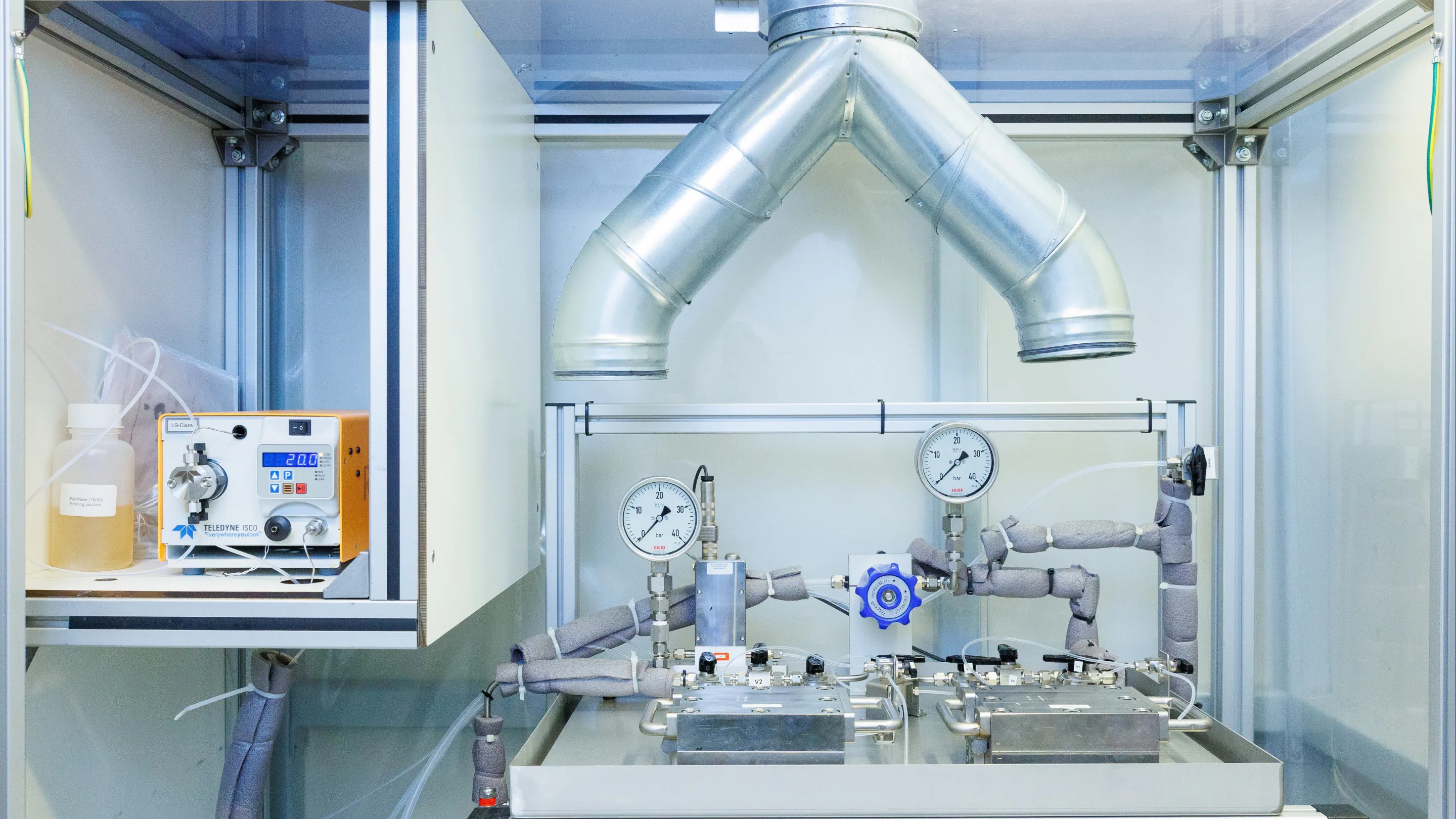
As part of this project, EMI Twente performed a nanofiltration performance study to investigate whether the adsorption regenerate could be concentrated before further treatment. The regenerate consisted of a 70/30 ethanol water mixture. Concentrating this stream could potentially reduce the amount of solvent that needs to be evaporated, thereby lowering the energy demand of the overall process. For the study, EMI Twente used its organic solvent filtration setup. Two membranes were evaluated: the NF90 from Filtec and the NF150101 membrane from Solsep. Both membranes were tested during four days at a pressure of 35 bar.
During the experiments, both membranes showed an initial decline in flux. However, it was still possible to achieve a tenfold volume reduction of the regenerate. Rejections of the PFAS components remained between 89-99%. The NF90 membrane showed higher rejection of different PFAS components compared with the NF150101 membrane. Despite observed delamination signs when the NF90 membrane was exposed to the ethanol water mixture.
An important additional observation was that a large fraction of the PFAS present in the feed did not end up in the concentrate. This indicated that part of the PFAS most likely adsorbed inside the setup, including in the tubing and the membrane. To investigate this further, EMI Twente performed an additional experimental run with the NF90 membrane. In this run, the feed mixture was equilibrated with the setup by recirculating the feed for up to two weeks, while samples of the feed mixture were taken over time. This additional experiment confirmed that a large portion of the PFAS adsorbed inside the setup. This is an important finding when considering membrane filtration for streams containing PFAS, because adsorption in the system can influence the interpretation of filtration results.
EMI Twente helped us evaluate nanofiltration under relevant solvent conditions and provided valuable insight into membrane performance and PFAS adsorption effects in the test system.
Jordi Wevers
Process Engineer Wastewater