Access to clean water is becoming an increasingly urgent challenge. At the same time, industrial and agricultural processes are producing water streams that contain salts, nutrients and valuable materials that could potentially be recovered and reused. Electrodialysis offers an interesting approach to both challenges. This membrane process uses electricity to transport dissolved ions across ion exchange membranes. Unlike reverse osmosis, which uses pressure to push water through a membrane, electrodialysis removes ions from the water itself. This difference can make electrodialysis particularly attractive for the treatment of brackish water. It also opens opportunities for selective ion removal, material recovery and the reuse of water in industrial and agricultural processes.
How electrodialysis works
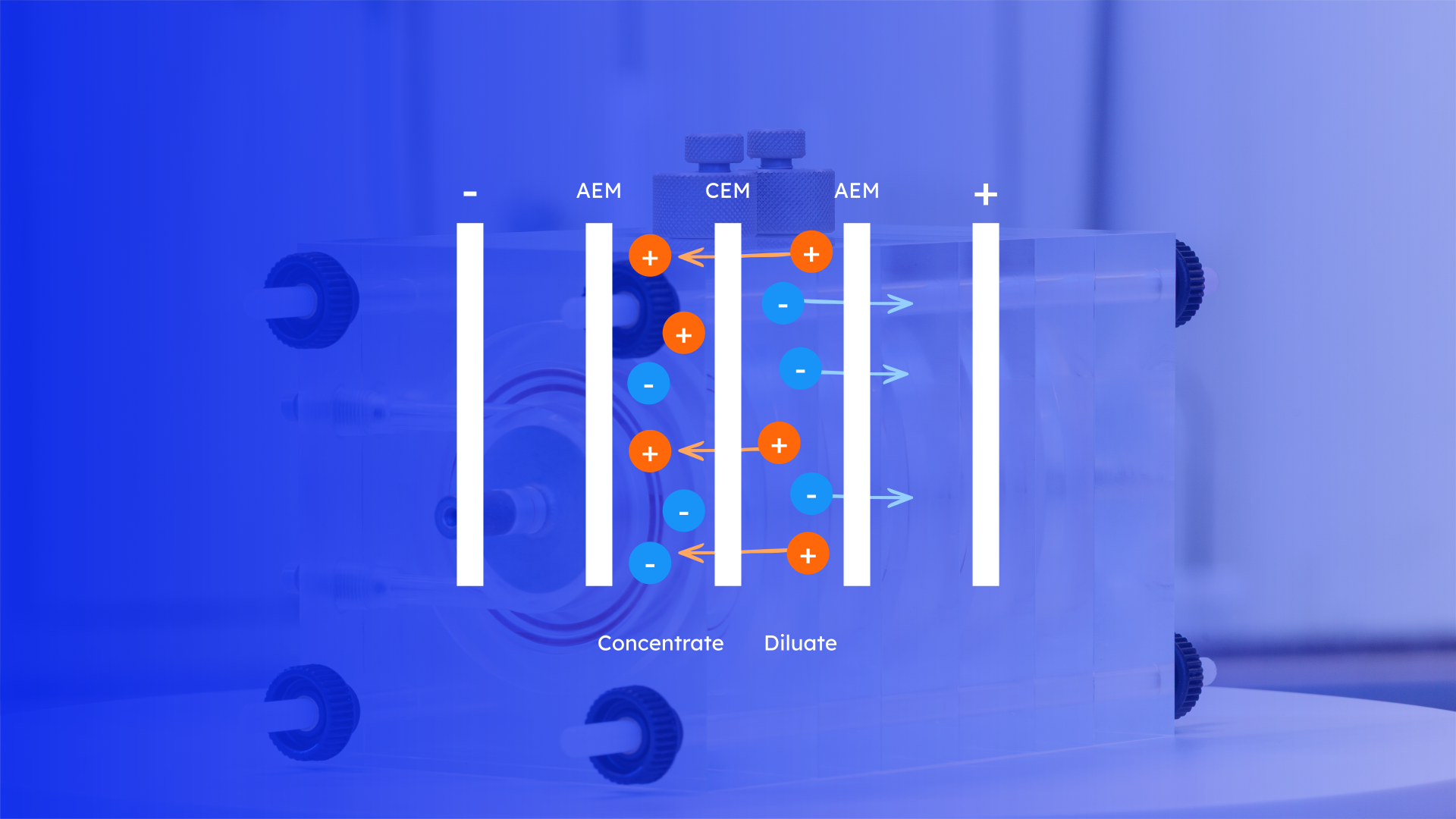
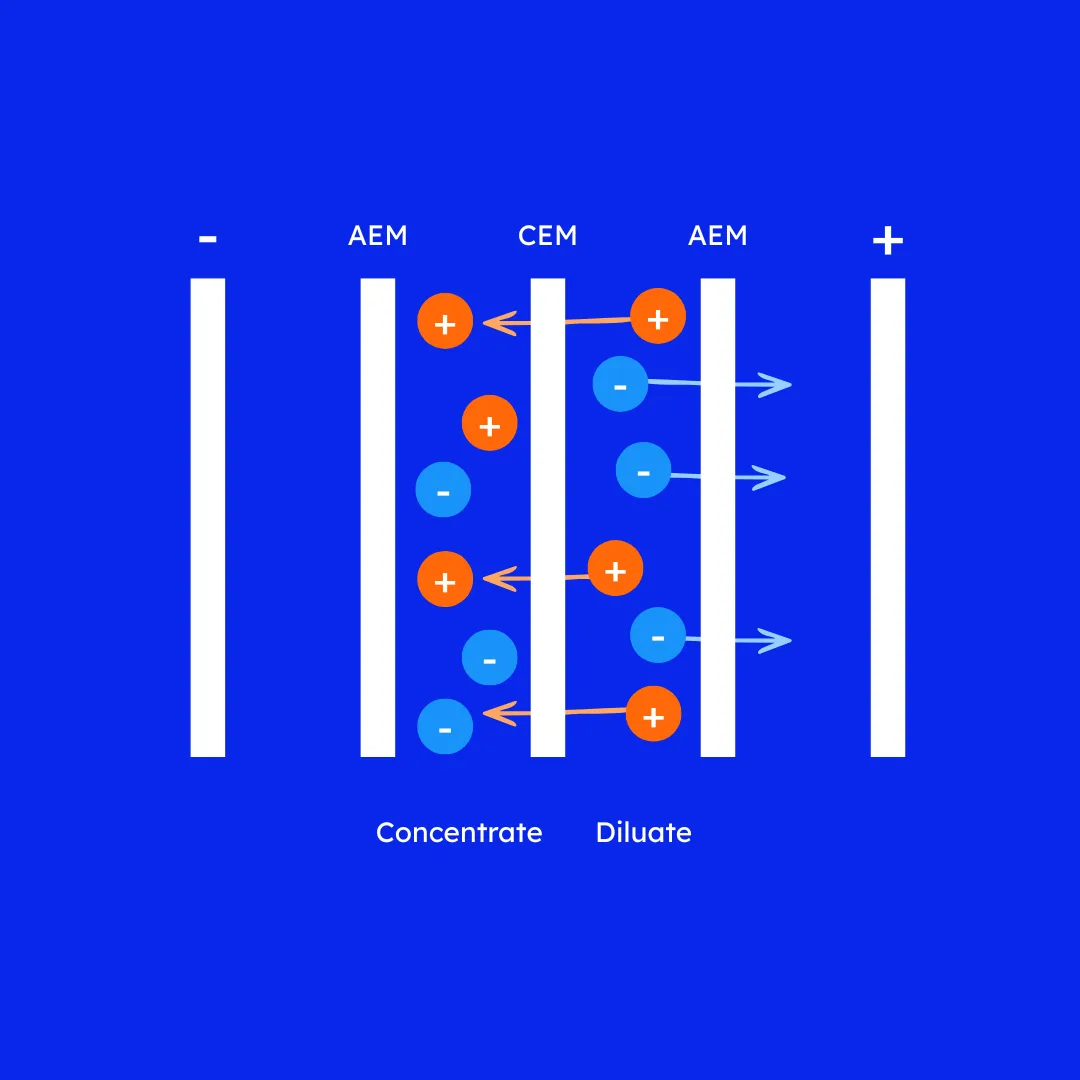
During electrodialysis, an electrical potential is applied across a stack containing alternating cation exchange and anion exchange membranes. The electrical field causes dissolved ions to move towards an electrode with the opposite charge. Cations pass through the cation exchange membranes, while anions pass through the anion exchange membranes. The arrangement of the membranes creates alternating channels. In one channel, the concentration of dissolved salts decreases, while the neighboring channel becomes more concentrated. The process therefore produces a desalinated stream and a concentrated stream without pushing the complete water flow through a membrane.
Electrodialysis vs Reverse Osmosis
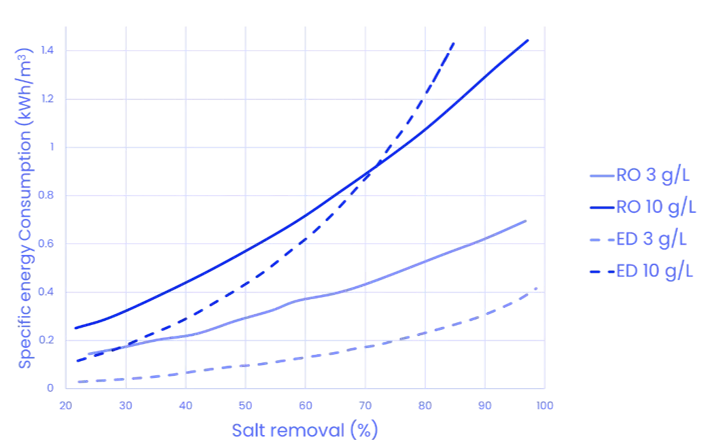
Electrodialysis is currently not as widely used in drinking water treatment as reverse osmosis. This is partly related to the types of water sources that are commonly used. In countries where freshwater resources are limited, drinking water production often depends on seawater desalination. For water with the high salt concentration of seawater, reverse osmosis is generally more energetically favourable. The balance can change when treating brackish water. Because electrodialysis transports ions rather than water molecules, it is thermodynamically more favourable at lower salt concentrations than reverse osmosis. This means that in these situations, pulling ions through the membranes requires less energy than pushing the entire water stream through a reverse osmosis membrane (see Figure, derived from: Patel, S. K., Biesheuvel, P. M. & Elimelech, M. Energy Consumption of Brackish Water Desalination: Identifying the Sweet Spots for Electrodialysis and Reverse Osmosis. ACS EST Eng. 1, 851–864 (2021)).
Brackish groundwater as a drinking water source
Brackish groundwater can be found in large parts of the world. It is especially relevant in regions where there is already insufficient access to safe and reliable drinking water. Treating these water sources with electrodialysis could help alleviate current water scarcity. It may also contribute to securing access to drinking water as pressure on conventional freshwater sources continues to increase. Whether electrodialysis is the right solution depends on the characteristics of the water. The salt concentration, ionic composition, required product water quality and local operating conditions all influence the performance and energy demand of the process. A careful assessment is therefore required before choosing between electrodialysis, reverse osmosis or another treatment method.
Recovering valuable materials from water streams
The potential of electrodialysis extends beyond the production of drinking water. Because the process transports ions, it can also be used to separate and concentrate components from industrial and agricultural streams. One possible application is the recovery of metal ions from mining waste streams or spent batteries. These streams can contain materials that are valuable but difficult to recover using conventional methods. Electrodialysis could support the separation and concentration of these ions, allowing them to be considered as resources rather than only as contaminants. A similar principle can be applied to agricultural groundwater containing nitrate and phosphate. Excess concentrations of these nutrients can eventually enter surface water and contribute to environmental problems. Electrodialysis could be used to remove and reconcentrate nitrate and phosphate from these streams. The concentrated nutrients could potentially be reused as fertilizer. This would both reduce the discharge of nutrients into the environment and decrease the need for additional fertilizer. In this way, electrodialysis can connect water treatment with material recovery and circular use of resources.
Selective ion removal with monovalent selective electrodialysis
Electrodialysis can also be designed to remove specific groups of ions while retaining others. One particularly interesting approach is monovalent selective electrodialysis. Ions with higher valencies are transported faster than monovalent ions in an electrical field. By using membranes that preferentially transport monovalent ions, the process can be directed towards the removal of selected ions. This could, for example, support water recycling in greenhouses. Sodium and chloride can be harmful to plants when they accumulate in irrigation water. At the same time, the water may contain multivalent cations that should preferably be retained. Monovalent selective membranes could remove sodium and chloride while keeping these multivalent cations in the water. This would allow a larger share of the irrigation water to be reused without removing components that remain useful for plant growth. The ability to distinguish between different types of ions makes selective electrodialysis relevant for applications where simple desalination is not sufficient.
Moving from process potential to practical application
At EMI Twente, we support companies in evaluating and developing electrodialysis applications. Depending on the development stage, this can include feasibility studies, membrane characterization, membrane screening, process development and testing at pilot scale. By combining membrane expertise with practical testing capabilities, we help translate an initial application idea into a process that can be evaluated under relevant conditions. Are you exploring electrodialysis for brackish water treatment, water reuse, selective ion removal or resource recovery? Contact EMI Twente to discuss the opportunities for your application.